
When Practice Misses What Matters
9 April 2026 (Edition 1)
Even when we think we are seeing clearly, our perspectives are tinted by our own inner processing, and the young person’s reality can remain unseen.
Welcome to the first edition of Shadows & Insight in Practice – a series exploring what often lies in the depth of professional work with children, young people, and families. These reflections are for practitioners, supervisors, and leaders, and are grounded in bringing to light the shadows within professional practice. Our aim is to make the invisible visible, keeping work aligned with ‘what matters most’.
Each edition centers on one key question: ‘How is this experienced by the young person?’ By keeping their perspective in focus, we remember that experiences are shaped by the past, present, and future, and that accountability to their lived reality is ongoing.
My hope is these reflections lead to clearer, safer practice and better outcomes for children, young people, and their families.
Shadows Within Professional Practice
In complex work, there is always more happening than we can see – within families, within systems, and within individual, team and organisational practice. Risk is not always located where we expect; at times, it sits within practice itself – in how we interpret what is happening, make decisions, respond and intervene.
Risk does not only sit within the family; it can sit within practice and service delivery itself.
Every day, practitioners make decisions intended to support, protect, and create change for children, young people and their families. These decisions are not only based on policy, process, timeframes and structured assessment, but are also influenced by inner drivers – defence mechanisms, anxiety responses, survival strategies, assumptions and cognitive bias, which intersect with the complexities that exist within systems.
These inner responses form shadows in practice. They are, more often than not, unconscious influences that quietly shape assessment, planning, and intervention. These unseen dynamics can increase risk of harm within the family environment, rather than supporting their safety and wellbeing.
Why does this matter?
Every practice decision carries influence; when unseen patterns go unrecognised, risk for the young person can increase.
For children and young people living with adverse experiences, such as family violence, neglect, poverty, parental mental health, addiction or intergenerational trauma, safety, stability, and attachment can be profoundly fragile. Practice decisions can carry significant and multi-layered influence.
When shadows within professional practice go unrecognised, they shape what we notice, what we minimise, how we make meaning of a family situation and what we prioritise.
This can look like:
-
Assumptions or bias shaping interpretation of information
-
Minimising or rationalising harm within the home
-
Alignment with adult narratives rather than the young person’s reality
-
Focusing on compliance and process, above the young person’s best interests
-
Urgency and crisis-driven practice which overrides reflection
-
Responses that unintentionally mirror the harmful dynamics we are seeking to change.
The experience of the young person mirrors what our practice fails to notice.
Through these shadows in practice, a young person’s voice can be diminished or silenced, assessments may fail to capture their lived experience, and decisions may move further away from establishing safety and supporting wellbeing. The impact can be significant, impacting a child or young person’s life and health outcomes across their lifespan.
Understanding Professional Dangerousness
The concept of Professional Dangerousness helps us name how risk can be generated or increased within professional practice, particularly when complexity, uncertainty, and anxiety are high. It describes the ways in which unconscious processes can distort assessment, planning, and intervention across individual practice, teams, and interagency systems – even with good intentions.
Tony Morrison (1990) described Professional Dangerousness as: “The process whereby professionals involved in child protection work can behave in a way which either colludes with or increases the dangerous dynamics occurring within the abusing family.”
This concept is still very relevant today and extends far wider than the statutory child protection context it originated from. Professional Dangerousness exists within ALL human services, including youth justice, mental health, addiction services, education, out-of-home care, and family support.
Professional Dangerousness is not about blame; it is about recognising that practitioners, supervisors and leaders draw on internal responses in their work. These responses, when left unrecognised, denied or ignored, can inadvertently align with adult narratives, increasing risk of harm for children and young people.
Beyond individual practice
Professional Dangerousness does not only operate at the level of individual practice. It also operates within team dynamics and across interagency systems and processes. It can emerge across systems for a multitude of reasons, including:
-
Pressure for out-puts, outcomes and KPIs
-
High case loads
-
Contractual requirements and constraints
-
Privacy and information sharing processes
-
High-pressured and crisis-driven environments
-
Competing for funding
-
Lack of interagency and multi-disciplinary training
-
Unclear boundaries
-
Poor risk assessment processes.
The list goes on!!
Decision-making can become more reactive than reflective, compliance can override what is best for the young person, and the service can be operating in its own survival mode. Attention can shift from the young person toward managing demand, risk, and competing priorities.
In these conditions, shadows deepen and their influence can become multi-dimensional and harder to detect.
Bringing the shadows into view
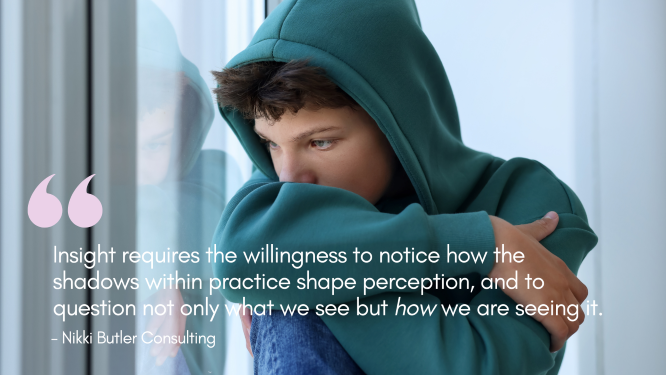
Insight requires the willingness to notice how the shadows within practice shape perception, and to question not only what we see but how we are seeing it.
Since shadows often sit outside of awareness, insight requires bringing them into view. Insight involves looking inward at how we make meaning when working in areas of emotional overwhelm and high complexity and looking outward at how our practice is experienced by the young person – how it is experienced in real time and across dimensions of time.
We bring unconscious processes into view through awareness, reflection, and intention. When we begin to recognise and reflect on the shadows within practice, their influence can shift. Conscious practice turns what is hidden into what is understood. What is understood can be responded to in a way that increases safety, wellbeing and enhances positive life outcomes.
Shifting practice in this way shifts what is possible for children, young people, and families at the centre of our work.
Returning to what matters
At the heart of these reflections is the question that anchors the series: “How is this experienced by the young person?”
This question recenters practice. It helps us evaluate assumptions, notice our defence mechanisms and coping strategies, and make choices that are accountable to the young person’s lived reality. It reminds us that a young person’s experience is cumulative – shaped over time through relational interactions.
We need to ask ourselves…
-
Has the young person had their story, feelings and experiences truly heard?
-
Have we taken time to build connection and trust, so that engagement becomes meaningful?
-
Have we held emotional space with them, before attempting to reframe their experience?
-
Have their survival strategies and resistance been acknowledged and valued?
-
Have they been seen for who they are, rather than defined by outward behaviours?
Recentering our practice creates an opportunity for meaningful change.
A Real-world Reflection
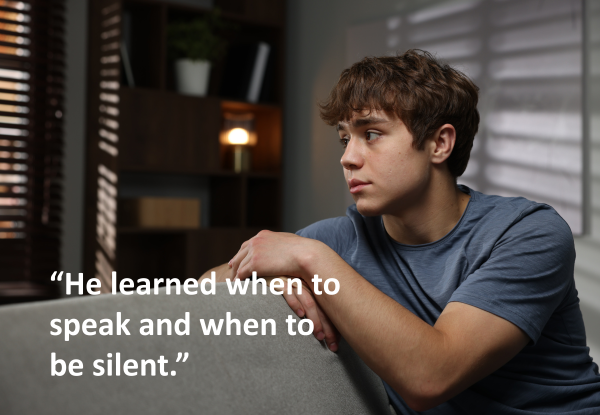
Jayden learned, over time, when to speak and when to be quiet. He was thirteen when the family was referred to a family support service for conflict at home, school refusal, and relational tension since his mother’s partner moved in. During the assessment and planning phase, three home visits took place, where it was documented that Jayden was present.
Initial family meeting
In the first home visit, Jayden’s mother spoke with quiet exhaustion, wanting things to improve, unsure how to hold it all together. Her partner described the need for clearer boundaries and consistency. There was no hostility, no obvious conflict, just a shared concern. The practitioner listened, asking questions to help form an understanding. Jayden sat off to the side, within earshot. When asked how he was, he shrugged, “fine.”
The conversation continued with Jayden’s mother and her partner.
Planning for change
On the second visit, the adults were well engaged. They discussed routines and expectations. The practitioner worked alongside them, building on their motivation. There was alignment. Jayden drifted in and out of the room. When he stayed, he was mostly quiet. When his behaviour was described, he didn’t interrupt. When his stepfather spoke, his attention shifted subtly.
Small moments were momentarily noticed… a pause before answering, a glance toward his mother. Mumbled words, “it’s different now that he’s here.” His mother responded gently, “We’re all adjusting.” Her partner nodded, “It’s about consistency.”
The practitioner stayed focused on developing the family plan – the way forward. The moment for exploring Jayden’s mumblings passed.
Working on family goals
By the third home visit, progress was clear. Jayden’s mother mentioned the improvements – fewer arguments and clearer expectations. Jayden was even attending school more often. The work felt meaningful. Midway through the visit, Jayden’s mother stepped out to use the bathroom and his stepfather hadn’t arrived yet.
For a brief moment, it was just Jayden and the practitioner. Without prompting, Jayden quietly said, “He gets sketchy… you never know when. I try not to make it worse by saying the wrong thing. Most of the time I just say nothing.” His tone was calm, just stating the facts. There was no sense of alarm.
A car pulled into the driveway; his stepfather was home, and his mother returned into the room. The conversation shifted back to adult discussions about goals and next steps. Jayden stayed quiet and composed.
“He had learnt when to speak and when to stay silent.”
Learnings for practice
This real-world reflection shows how professional practice, even when well-intentioned, can collude with adult narratives, shaping whose voices are heard.
Alignment can reinforce adult authority: Focusing on routines, consistency, and strategies without exploring the young person’s perspective leaves them unheard.
Silence becomes adaptive: Young people notice which voices carry weight. When their attempts to communicate are unsafe, silence becomes survival.
Harm can continue quietly: Harm is not always visible. When adult perspectives are validated over the young person’s experiences, harm can continue unseen.
Small moments matter: Hesitations, glances, and hints of discomfort, can signal experiences different to adult narratives. Harm can continue when these are overlooked.
Professional awareness is key: Practitioners need to notice whose voices are shaping assessment, recognise patterns of collusion, and explore the young person’s experience, ‘with the young person’.
How did Jayden experience the intervention?
Jayden experienced the intervention as a space where the adults’ version of events carried the most weight – shaping what was noticed, explored, and acted on. Within this, his attempts to signal something different were not explored, teaching him that speaking up would not shift the narrative or his situation.
Over time, Jayden adapted by becoming even quieter, learning that silence was the safest way to navigate both the home and the professional space, and at the same time, what he was living with at home quietly escalated.
The coercive control from his stepfather, slowly over time, impacted his sense of self-worth, value and belonging.
Insight of the Month
The greatest influence in practice is not what we do, but it is in the story we come to hold and who is still waiting to be heard.
Even purposeful and well-intended work can protect adult narratives and inadvertently silence young people. Being attuned to these dynamics, creating space for meaningful conversations, and noticing what remains unspoken are essential strategies to ensure young people’s realities are visible, acknowledged, and addressed.
An Invitation
When we shine light on the shadows in practice, risk becomes visible, practice decisions become intentional, and meaningful change becomes possible.
This series is an invitation to pause, especially when the work feels highly complex, urgent, emotionally overwhelming, or unsafe, and consider the hidden drivers quietly shaping practice decisions.
It is an invitation to notice what lies beneath the surface, to bring the shadows into view, and to strengthen how we think, decide and act. I encourage you to deepen your reflection… to notice your thought processes and what you might be avoiding, minimising or denying in the practice context.
This invitation asks us to hold two perspectives at once:
-
Awareness of our internal processes
-
Intentional focus on the lived experience of the child or young person.
It is through this dual awareness that practice becomes intentional, transparent, accountable and responsive, in a way that enhances outcomes for families. When we are reflective and aware in our practice, we not only improve practice, but we also increase safety, reduce harm, and create conditions for meaningful change.
Change that ripples into future generations. Our practice and service responses are never only about present time.
Coming Up Next…
In future editions, we will reflect on the key devices of Professional Dangerousness and how they manifest in practice.
This includes a deeper exploration of:
-
Natural Love
-
Cultural Relativism
-
Reframing Care and Control
-
Survival Responses
-
Misplaced Optimism
-
The Concept of Helping.
These key devices influence how families are engaged, the ways in which their circumstances are explored, how risk is assessed, and how the child and young person’s experience is kept central (or invisible) in service responses.
As connected topics, I am excited to be speaking at the following conferences….
- AddictionZ Conference, Gold Coast, May 2026: “Changing the Narrative for Young People Living with Parental Addiction: A Trauma-informed and Strengths-based Approach.” To register: AddictionZ 2026
- Ending Coercive Control, Family & Domestic Violence Conference, Sydney, 28-29 July 2026. “Unsilencing Voices of Children and Young People who Experience Family Violence: Recognising the Language of Harm.” To register: Ending Coercive Control & Family Violence Conference NSW – The Hatchery
In Closing...
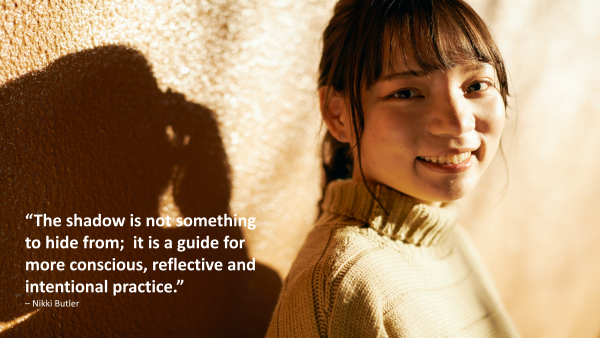
The shadow is not something to hide from; it is a guide for more conscious, reflective and intentional practice.
Professional Dangerousness does not stem from ill intent, it emerges in the shadows, where unconscious bias and defence mechanisms subtly shape responses to family situations. Flawed assessment silences young people and leads to ineffective interventions. It can unintentionally increase harm existing within the home.
Conscious practice encourages practitioners to consider the impact of their actions on others, engage in ongoing learning and self-reflection. Reflective practice shines a light on these shadows. By slowing down, questioning assumptions, centering the young person’s perspectives, and deepening our reflection, vulnerabilities can be bought into awareness and wellbeing for young people increased.
Let’s intentionally reflect… “In what ways are our own inner processes, team dynamics and interagency processes impacting our understanding, decisions and responses?”
And most importantly, “How is this experienced by the young person?”.
I invite you to join this reflective conversation – different perspectives help us shine light on the hidden aspects of individual practice, team dynamics and interagency collaborations.
Young people need our full attention – to our own detail and to theirs – now more than ever!
ABOUT ME...
It always feels strange writing about myself, but here I go…
I have provided leadership, consulting and training for over 35 years (eeeek!) across Australia and New Zealand, in government, non-government and community contexts.
Professional Dangerousness has been a specific interest of mine for over 20 years – undertaking action research in the health context, studying the link with conscious practice, developing resources and being a member of New Zealand’s Child & Mortality Review Panel. Professional Dangerousness dynamics continue to be evident in child maltreatment deaths (in Australia, NZ, UK and beyond) yet are largely underrecognised.
Without understanding the dynamics, manifestations and ‘antidotes’, upholding child and youth rights to wellbeing and safety is compromised.
My overall focus is on equipping professionals to stay grounded, reflective, and effective in complex work, increasing practice insight and improving outcomes for children, young people, and their families. Through Shadows & Insight in Practice, I’ll share reflections that bring hidden dynamics into view and keep the lived experience of children and young people central to practice.
VOICES OF IMPACT
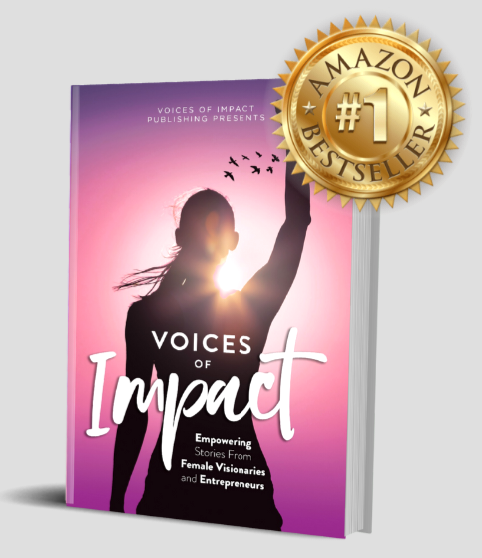
I am honoured to be a co-author in Voices of Impact Vol.3, 2023. The book carries the life experiences and transformations of 24 amazing women, taking courage to share their stories and make a difference in the world.
My chapter, ‘Inspiring change, transforming lives’, is inspired by my own child and adolescent life experiences, where I heard my own whisper for change. I have come to realise that it is often one decision that changes everything.
When we bring our stories into the light, rather than hidden within, we not only release our own voice, but we can also create a ripple effect in the lives of others.
MOST RECENT BLOGS
When Practice Misses What Matters
The Hidden Shadows within Practice: How Professional Dangerousness Silences Young People
The Impact of Parental Addiction on Children and Young People: A Trauma-Informed Approach
Beneath the Surface of Youth Offending: A Personal Reflection
Rethinking Responses to Youth Offending: A Trauma-Informed Approach
Building a Resilient Workforce: Why Mental Fitness Matters for Practitioners Supporting Children, Young People, and Families.