
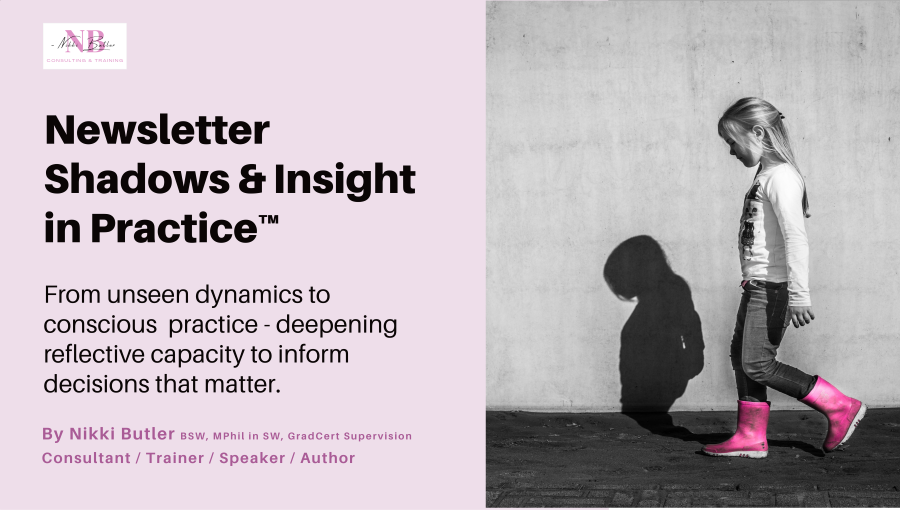
When Strengths Overshadow Harm
In this edition of Shadows & Insight in Practice, we explore how identified strengths can shape the way we understand risk and harm when working with children, young people and their families. Through the lens of Professional Dangerousness and The Rule of Optimism, we consider how strengths-based practice can unintentionally draw attention away from circumstances that continue to harm a child or young person.
The Shadow Side of Strengths-Based Practice
What if our commitment to seeing strengths is also making harm less visible?
Strengths-based practice has helped shift work with children and families away from deficit-based approaches towards recognising capacity, relationships, resources, protective factors and possibilities for change. It encourages us to see families within their broader lives rather than define them by their difficulties.
A focus on strengths does more than add positive information to an assessment. It can shape the professional story we develop about a family, including how we understand capacity and progress, what we see as protective, and how we interpret risk.
Complications arise when strengths begin to take on meaning that overshadows other factors. Engagement may become a sign of change, positive relationships may be viewed as protective, and progress in one area may influence how we understand concerns in other areas.
This is not an argument against strengths-based practice or its valued emphasis on partnership and existing capacity. It is an invitation to consider when a focus on strengths begins to influence how we interpret risk.
A strengths-based narrative can become more influential than the strengths themselves. What is going well may become the context through which continuing harm is explained or given less attention. Risk may be overlooked when strengths-based interpretations are adopted before the nature, pattern and seriousness of harm have been fully assessed.
It is important to reflect…
- Do the identified strengths increase safety?
- Are they available when needed?
- Do they change the conditions creating risk and harm?
- Do the identified strengths reassure us, without changing the child or young person’s experience?
Identifying strengths and protective factors remains essential to holistic assessment. The harder task is determining what they mean for the child or young person’s safety and wellbeing.
Balancing the Professional Narrative

A holistic assessment is not a balance sheet between strengths and risk.
Consider what happens when strengths are treated as if they offset risk… Several strengths do not cancel out or balance significant risk. A family may have many strengths and only one apparent risk factor, yet that single factor can result in serious harm.
When strengths are viewed as signs of safety, progress or protection, they can begin to outweigh the significance of ongoing concerns, influencing decisions in ways that may not adequately protect the child or young person.
The shift can be subtle, and any of us can be drawn into it. We rarely decide consciously that a strength outweighs a risk. Instead, positive information can gradually become more influential in how we understand what is happening. For example:
- Engagement may become evidence of motivation and change.
- School attendance or achievement may be interpreted as evidence of resilience.
- Family or community connections may be viewed as evidence of protection.
A strengths-dominant assessment develops when positive information becomes the lens through which other information is interpreted. As positive information becomes more influential, it can begin to shape what practitioners notice, prioritise and give meaning to. When what is going well remains prominent, factors that are causing harm can become easier to overlook.
This is not a failure of commitment to child protection. It can be an unintended consequence of a practice approach that has become deeply embedded in professional thinking. Attention may shift towards capacity, engagement and resources, making a strengths-based approach feel appropriate, even when the circumstances and factors causing harm to the child have not changed.
Let’s pause for a moment… what might be influencing the meaning we give to identified strengths within complex child, youth and family work?
The Optimistic Shadow
Tony Morrison’s (1990) concept of The Rule of Optimism helps explain how Professional Dangerousness can operate within practice. There can be a tendency for practitioners to favour more optimistic interpretations, particularly when faced with the anxiety, uncertainty and responsibility that accompany complex work with children, young people and their families.
The Rule of Optimism does not mean that professionals consciously choose to ignore harm. It can operate subtly, outside of awareness. When the reality of a child remaining unsafe is difficult to navigate, optimism can influence how we make sense of the information in front of us. Engagement, effort, love, resilience, progress or the promise of future change can begin to carry greater weight, shaping how we understand what is happening.
Working with children and families in circumstances of ongoing harm can generate anxiety, uncertainty and a heightened sense of responsibility. It may require difficult conversations with parents, challenges within professional relationships, escalation of concerns or decisions with significant consequences.
These pressures can make a more positive interpretation of the family easier to sustain, even when the conditions causing harm are unchanged.
The Rule of Optimism can influence professional meaning-making by changing the weight given to available information. It does not necessarily remove concerning information from the assessment. Risk may still be acknowledged but explained. Harm may be recognised but minimised. Concerning behaviour may be rationalised in the context of stress and family circumstances. Repeated incidents may be understood as isolated events, while the possibility of future change begins to be treated as evidence that change is already occurring.
The shadow emerges when optimism subtly influences what we notice, what we address and the weight we give to indicators of continuing harm.
The Rule of Optimism can also shape the meaning attached to identified strengths. In practice, this might be expressed as:
- The parent is engaging with services now and starting to make progress.
- This was the best option available at the time; they did the best with what had.
- I’m sure it was an accident; they would never intentionally hurt their child.
- Everything will be fine now that…
- There is a lot of capacity in this family to make the necessary changes.
These statements may reflect genuine strengths or progress, but they do not necessarily mean that things are safer for the child or young person.
Such interpretations can become further embedded through professional conversations, including supervision and leadership. When engagement, progress, capacity and what is going well receive greater attention than what continues to be harmful, optimistic interpretations can gradually become part of the accepted professional narrative.
Ongoing assessment requires us to keep questioning that narrative:
What has changed? What remains harmful? Has the child’s everyday experience become safer?
The Rule of Optimism becomes dangerous when the account we want to be true carries more weight than what the indicators are telling us about the child or young person’s experience.
Real-World Example: Kira’s Story

Kira is thirteen. Her teachers described her as bright, capable and conscientious, with positive connections at school. She attended, achieved and appeared to be coping. From the outside, little suggested how difficult life had become for her at home.
Kira’s family faced significant and escalating risk. Her father’s substance addiction increasingly shaped his priorities, with drugs sometimes taking precedence over food. When affected by drugs, he became emotionally disconnected from Kira and her sibling, and from what was happening within the family.
The addiction cost more than the family earned, leaving them short of food, behind in rent and unable to afford what Kira’s peers took for granted. Kira became increasingly aware of the differences between their lives and that of her friends, hiding the circumstances she did not want others to know.
Kira withdrew most of the time to her room and was disengaging from family life, reflecting how alone she felt with circumstances she could not control. The increasing social gap intensified her isolation.
No one knew she was experiencing suicidal thoughts or losing hope that life at home would change.
At the same time, Kira’s father loved his children, worked long hours in his mechanics business and took pride in providing for his family. Her mother worked hard to hold the family together while managing financial pressure and addiction. Both parents wanted things to improve.
Professionals identified genuine strengths: Kira’s father was dedicated to his family and engaged with an addiction counsellor; her mother maintained stability; and the family had a strong support network. Together, these factors suggested capacity and commitment to change.
These strengths offered genuine hope, but the critical question was whether love, income, service engagement and family support made food reliable, housing secure and caregiving emotionally available. Without evidence of these changes, the strengths did not demonstrate a safe home environment or emotional wellbeing for Kira.
The positive signs were real. So was the harm.
How was this experienced by Kira?

Kira’s attendance, achievement and relationships suggested she was coping, while her parents’ love and her father’s engagement with counselling indicated the family could progress. When these positive signs carried greater influence in professional understanding, her isolation, hopelessness and suicidal thoughts became less visible.
For Kira, the consequences were significant. Her withdrawal and isolation were part of how she was managing circumstances she could neither control nor talk about safely. While professionals saw resilience and family capacity, Kira was experiencing uncertainty, unmet needs, emotional disconnection and a growing sense of hopelessness.
Kira needed adults to see both her resilience and distress. Until professionals recognised the growing risk to her mental health, she had little reason to believe she would be heard or that support would help her family’s circumstances change.
The strengths that professionals saw were real, but they were also not the whole story.
An invitation to reflect
Kira’s story shows how genuine strengths can influence the professional story without changing a child’s lived experience. Her father’s employment, parental love, engagement with services and family support were meaningful strengths. The critical reflection is whether those strengths were changing what Kira and her sibling experienced in their everyday lives.
The strengths were valid. The shadow emerged when they began to influence how the continuing harm was understood.
A strength can exist without protecting the child. In Kira’s home, parental and family strengths had protective value only to the extent that they reduced the effects of addiction, financial insecurity and emotional strain in her everyday life.
The challenge is to hold strengths and risk together while looking for signs that the child or young person’s circumstances are changing. For Kira, this meant assessing whether food and housing were secure, if her parents were emotionally available, and whether she was able to talk about what was happening.
Love, effort, resilience and engagement can coexist with addiction, unmet needs and significant harm.
Whether you are working directly with a child or family, providing supervision or shaping a service response, consider:
- What do the identified strengths mean for the young person’s safety and wellbeing?
- Has engagement resulted in sustained behavioural change?
- Has the addiction reduced its impact on the children?
- Is there greater safety and stability in the child’s everyday life?
- Are the identified strengths available when they are needed?
- Are expectations becoming more flexible because we want the plan to succeed?
Reflective practice asks whether the professional story is becoming more influential than the child or young person’s lived experience.
Insight of the Month
A strength tells us something about the young person’s capacity, but it does not always tell us about the circumstances in which the strength was formed.
Some of the qualities we recognise as strengths may also reflect how a child or young person has adapted to their lived experience, for example:
- A young person who is exceptionally independent may have learned not to rely on adults.
- A child who appears highly responsible may be carrying responsibilities that should never have been theirs.
- A young person who is calm, accommodating and undemanding may have learned that expressing their needs is unsafe.
These examples invite us to ask ourselves: “What has this young person needed to learn or do in response to their circumstances? What has this adaptation helped them manage, and what might it be making harder for them to express, ask for or receive?”
Gaining insight means recognising a young person’s capacity while remaining curious about how that strength developed, what it has helped them manage and whether they still need to rely on it to feel safe.
Coming Up Next…
Previous editions of ‘Shadows & Insight in Practice’ have explored Fear Responses, Biased Assessment, Misplaced Practice and Reframing Care and Control. This edition has explored how The Rule of Optimism can influence the way strengths, risk and harm are understood.
In the coming months, we will continue uncovering the key devices of Professional Dangerousness including Adaptive Practice, Natural Love, Cultural Relativism and The Concept of Helping.
These devices shape how families are engaged, how risk is understood and how children and young people remain visible – or become invisible – within professional and service responses.
ALSO…

I’ll be offering a free webinar: “Understanding the Impact of Parental Addiction on Children & Young People: A Trauma-Informed Approach.”
This webinar draws on my childhood experience of parental heroin addiction, professional experience, contemporary research and practice wisdom. It explores what parental addiction can mean for children and young people, and how we can respond in ways that keep their experiences visible within the professional response.
Date to be announced.
In Closing…
A strength is protective only when it enhances the child or young person’s lived experience.
Professional Dangerousness can take shape unconsciously and with good intentions when strengths become more influential than indicators of harm.
Our knowledge, relationships and resources can support safety, while assumptions, emotional responses and organisational pressures shape what we notice and act on. This is both a practice and leadership responsibility.
The professional task is not to identify fewer strengths, but to evaluate what they change in the everyday life of the child or young person.
Our purpose is not to create a more positive professional story, but to understand and respond to what the child or young person needs. We must ask whether our involvement has increased their experience of safety and supported their wellbeing.
As a final reflection…
Where might positive information be shaping what you notice, question or act on in your own practice, supervision or leadership? What helps you keep the child or young person’s lived experience visible when genuine strengths exist alongside continuing harm?
I welcome your reflections and your thoughts.
References:
- Australian Institute of Family Studies. (2025). Risk and protective factors for child abuse and neglect. Australian Government.
- Cousins, C. (2005). The ‘rule of optimism’: Dilemmas of embracing a strength-based approach in child protection work. Children Australia, 30(2), 28–32. https://doi.org/10.1017/S1035077200010671
- Morrison, T. (1990). The emotional effects of child protection work on the worker. Practice, 4(4), 253–271.
- Revell, L., & Burton, V. (2016). Supervision and the dynamics of collusion: A rule of optimism? The British Journal of Social Work, 46(6), 1587–1601. https://doi.org/10.1093/bjsw/bcv095
- White, S., Hall, C., & Peckover, S. (2021). Framework for the Assessment of Children in Need and Their Families and Signs of Safety: Competing or complementary frameworks? The British Journal of Social Work, 51(7), 2571–2589. https://doi.org/10.1093/bjsw/bcaa058
ABOUT ME
I have over 35 years’ experience providing leadership, consulting, and training across Australia and New Zealand in government, non‑government, and community settings, including child protection, health, disability, family support, addiction, education, out‑of‑home care, and local government.
My professional experience also includes several years working with pregnant teenagers and young mothers, including supporting young people during pregnancy and the transition into parenting.
In New Zealand, I led a multi‑service child protection initiative within the health context and served on the national Child and Mortality Review Group. In Australia, I am a recipient of a Queensland Child Safe Organisations Award for contributions to child protection.
For more than two decades, my practice has focused on Professional Dangerousness, including action research, training, and resource development.
Through Shadows & Insights in Practice, I aim to encourage professionals to remain reflective, grounded, and ethical in complex work, bringing hidden dynamics into view and keeping the lived experience of children and young people at the centre of practice.
VOICES OF IMPACT
I am honoured to be a co-author in Voices of Impact Vol.3, 2023. The book carries the life experiences and transformations of 24 amazing women, taking courage to share their stories and make a difference in the world.
My chapter, ‘Inspiring change, transforming lives’, is inspired by my own child and adolescent life experiences, where I heard my own whisper for change. I have come to realise that it is often one decision that changes everything.
When we bring our stories into the light, rather than hidden within, we not only release our own voice, but we can also create a ripple effect in the lives of others.
MOST RECENT BLOGS
- When Strenghts Overshadow Harm
- When Protection Increases Risk
- When Bias Becomes the Explanation
- When Fear Becomes the Driver
- When Practice Misses What Matters
- The Hidden Shadows within Practice: How Professional Dangerousness Silences Young People
- The Impact of Parental Addiction on Children and Young People: A Trauma-Informed Approach
- Beneath the Surface of Youth Offending: A Personal Reflection
- Rethinking Responses to Youth Offending: A Trauma-Informed Approach
- Building a Resilient Workforce: Why Mental Fitness Matters for Practitioners Supporting Children, Young People, and Families.